Chapter 3: Completing the Space-Time Diagram Discussion
Here we will complete the discussion of the space-time diagrams which we
began in the previous chapter. We will do this by completely comparing the
coordinates our observers have for a particular event. To make that comparison
we will need to see how the lengths which represent one unit of space and time
in the reference frame of  compare with the lengths representing the same
units in
compare with the lengths representing the same
units in  . The easiest way for us to do this is to use information we have
already seen--in particular, we use the fact that a clock moving with respect to
an observer seems to be running slowly to that observer and a pole moving with
respect to that observer seems to be shorter to that observer by a factor of
. The easiest way for us to do this is to use information we have
already seen--in particular, we use the fact that a clock moving with respect to
an observer seems to be running slowly to that observer and a pole moving with
respect to that observer seems to be shorter to that observer by a factor of
 . (Note: this was explained in Chapter 1. of this FAQ.)
Understanding how to use this in the space-time diagram in order to completely
construct the two observers' coordinate systems should give some solid insight
into time dilation and length contraction in special relativity.
. (Note: this was explained in Chapter 1. of this FAQ.)
Understanding how to use this in the space-time diagram in order to completely
construct the two observers' coordinate systems should give some solid insight
into time dilation and length contraction in special relativity.
So, how do we show time dilation on our space-time diagram. Well, the key to
this can be found by expressing time dilation in the following way: In the
observer's frame of reference, let the tick  of his clock be
simultaneous with the tick
of his clock be
simultaneous with the tick  of the observer's clock. Also, let
the tick
of the observer's clock. Also, let
the tick  of his (the observer's) clock be simultaneous with the
 tick of the observer's clock. Then, we would find that
(Eq 3:1)

where gamma () (as defined in Section 1.4) would be
calculated using the relative velocity of and . What Equation 3:1
says is that in the observer's frame of reference, the difference in the
ticks of the observer's clock is smaller than the difference in the
observer's own ticks by a factor of . Thus, we see that in the
frame of , the observer's clock is running slowly.
As an example, from here on we will consider the case where the relative
velocity is  such that
  . Using an example
like this will make the procedure easier to understand for the reader; however,
remember that we could redo this whole process with any speed (calculating a new
factor, drawing a different speed for the observers, drawing
appropriate lines of simultaneity, etc.).
. Using an example
like this will make the procedure easier to understand for the reader; however,
remember that we could redo this whole process with any speed (calculating a new
factor, drawing a different speed for the observers, drawing
appropriate lines of simultaneity, etc.).
Now, what if we let the tick be the "zero" tick. That means that at the
origin, when both of our observers are right next to one another,  . So, both of the observers agree (because there is no separation
between them in space at the origin) that and are
simultaneous, and happen at
. So, both of the observers agree (because there is no separation
between them in space at the origin) that and are
simultaneous, and happen at  . However, after some time, there will be
a tick () on the observer's clock. In the frame of reference of ,
that tick is simultaneous with the tick of the observer's clock.
Since
, and we are using , we know (from Equation 3:1) that
. However, after some time, there will be
a tick () on the observer's clock. In the frame of reference of ,
that tick is simultaneous with the tick of the observer's clock.
Since
, and we are using , we know (from Equation 3:1) that
(Eq 3:2)

So, this says that in the frame of the observer, the tick of his
clock is simultaneous with the tick  on the observer's
clock. If we draw a line of simultaneity in the observer's frame of
reference such that it goes through the tick of his clock, then it must
also go through the tick of the observer's clock. If we
let
on the observer's
clock. If we draw a line of simultaneity in the observer's frame of
reference such that it goes through the tick of his clock, then it must
also go through the tick of the observer's clock. If we
let  second, then we get what is shown in Diagram 3-1.
The distance from the origin, o, to the first mark along
second, then we get what is shown in Diagram 3-1.
The distance from the origin, o, to the first mark along  in that diagram is
defined to be 1 second for our observer. Meanwhile, the distance from o to
the "*" symbol along
in that diagram is
defined to be 1 second for our observer. Meanwhile, the distance from o to
the "*" symbol along  in that diagram is 0.8 second for the O'
observer. So, we begin to see that we can relate distances in time along the
axes of the different observers.
in that diagram is 0.8 second for the O'
observer. So, we begin to see that we can relate distances in time along the
axes of the different observers.

This puts us on our way to understanding how, for example, different lengths
along and relate to particular times on the clocks of the two
observers. Our next step to understanding this better will be to look at the
situation from the observer's frame of reference.
We have found what tick of the observer's clock is simultaneous with
the  tick of the observer's clock in the observer's frame of
reference. However, say we want to decide what tick is simultaneous with
the observer's tick in the observer's frame of reference
(remember, the line of simultaneity in Diagram 3-1 is only valid for the
observer's frame). To figure this out, we need to draw a line of
simultaneity in the observer's frame of reference which passes through the
event "the observer's clock ticks 1". When we do this, we want to note where
that line passes the axis, because that mark points out the tick on the
observer's clock which is simultaneous with observer's tick
in the observer's frame of reference. I have drawn this line in
Diagram 3-2, but I have also left everything that was in
Diagram 3-1.
tick of the observer's clock in the observer's frame of
reference. However, say we want to decide what tick is simultaneous with
the observer's tick in the observer's frame of reference
(remember, the line of simultaneity in Diagram 3-1 is only valid for the
observer's frame). To figure this out, we need to draw a line of
simultaneity in the observer's frame of reference which passes through the
event "the observer's clock ticks 1". When we do this, we want to note where
that line passes the axis, because that mark points out the tick on the
observer's clock which is simultaneous with observer's tick
in the observer's frame of reference. I have drawn this line in
Diagram 3-2, but I have also left everything that was in
Diagram 3-1.

Now, note that I marked the "%" symbol in that diagram (where the line of
simultaneity for --which goes through --crosses the axes) as the
event  . But how did I know that? Well, because in the frame of
reference of , it is the observer who is moving at , and thus it
is the observer who's clocks are running slowly by a factor of 1.25. So, in
the frame of , the event " at the observer's position" must be
simultaneous with the event " at the observer's position." That
way, in the observer's frame, it will be the observer's clock which is
running slowly by a factor of 1.25. In addition, I could use the length from the origin to "*" (which I know is
0.8 seconds for the observer) to figure out how much time passes between
the origin and the "%" symbol for . Either way, I find the same thing.
. But how did I know that? Well, because in the frame of
reference of , it is the observer who is moving at , and thus it
is the observer who's clocks are running slowly by a factor of 1.25. So, in
the frame of , the event " at the observer's position" must be
simultaneous with the event " at the observer's position." That
way, in the observer's frame, it will be the observer's clock which is
running slowly by a factor of 1.25. In addition, I could use the length from the origin to "*" (which I know is
0.8 seconds for the observer) to figure out how much time passes between
the origin and the "%" symbol for . Either way, I find the same thing.
In Diagram 3-2, one can begin to see the power of using
space-time diagrams to understand special relativity. Note that from one glance
at that diagram not only can we see that in the observer's frame of
reference the observer's clock is running slow by a factor of 1.25 (i.e.
the event "" is simultaneous with the event " " in the
observer's frame) but we also see that in the observer's frame it is the
observer's clock which is running slow by a factor of 1.25 (i.e. the event
"" is simultaneous with the event "" in the observer's
frame). Thus, we can see at once on this diagram that in each observer's own
frame, the other observer's clock is running slow. This happens to be one of the
first, key points to understanding the twin paradox (which will be discussed
fully in the next section).
" in the
observer's frame) but we also see that in the observer's frame it is the
observer's clock which is running slow by a factor of 1.25 (i.e. the event
"" is simultaneous with the event "" in the observer's
frame). Thus, we can see at once on this diagram that in each observer's own
frame, the other observer's clock is running slow. This happens to be one of the
first, key points to understanding the twin paradox (which will be discussed
fully in the next section).
So, we have found a correlation between the lengths which represent certain
times along the axis for and the lengths which represent certain times
along the axis for . We did this by using (1) the idea of time dilation
which was found earlier to be caused by the fact that light always travels at c
for all inertial observers and (2) the lines of simultaneity for different
observers which we learned how to draw by also using the fact that light always
travels at c for all inertial observers. Similarly, we can find a correlation
between lengths which represent certain distances along the  axis for and
the lengths which represent certain distances along the x' axis for . As an
example, I have drawn a comparison of distances in Diagram 3-3 which
will be explained below.
axis for and
the lengths which represent certain distances along the x' axis for . As an
example, I have drawn a comparison of distances in Diagram 3-3 which
will be explained below.

Perhaps the best way to explain this diagram is as follows: Consider a rod
being held by the observer such that one end of the rod follows the axis
(and is thus always next to the observer) while the other end follows the
vertical line drawn at  . The rod then is obviously stationary in the
observer's frame of reference. Second consider a rod being held by the
observer such that one end follows the axis and the other end follows the
line of constant position for which I have drawn.
. The rod then is obviously stationary in the
observer's frame of reference. Second consider a rod being held by the
observer such that one end follows the axis and the other end follows the
line of constant position for which I have drawn.
Well, in the observer's frame, his rod is obviously 1 light-second
long. But notice that in his frame the ends of the observer's rod are next
to the ends of the observer's rod at  . Thus, in the observer's
frame, the observer's rod is also 1 light-second long. But length
contraction tells us that in the observer's frame, the observer's rod
is shorter than its "rest length" by a factor of 1.25. Thus, in the
observer's frame (the frame in which his rod is at rest), his rod must actually
be 1.25 light-seconds long. That is how I know that the line of constant
position for I drew was for
. Thus, in the observer's
frame, the observer's rod is also 1 light-second long. But length
contraction tells us that in the observer's frame, the observer's rod
is shorter than its "rest length" by a factor of 1.25. Thus, in the
observer's frame (the frame in which his rod is at rest), his rod must actually
be 1.25 light-seconds long. That is how I know that the line of constant
position for I drew was for  .
.
Now, look at the distance along  from the origin (o) to the point
marked "#". That distance represents the length of the observer's rod from
his own frame of reference (i.e. 1.25 light-seconds). Also, the distance along
x' from the origin to the point marked "*" represents the length of the
observer's rod in the observer's frame of reference. That distance must be
0.8 because in the frame, it is and his rod which are moving, and thus
his rod seems length contracted by a factor of 1.25 from its length in the frame
of reference in which it is at rest (the frame). That number could have also
been found by using the fact that the distance from o to "#" was 1.25
light-seconds.
from the origin (o) to the point
marked "#". That distance represents the length of the observer's rod from
his own frame of reference (i.e. 1.25 light-seconds). Also, the distance along
x' from the origin to the point marked "*" represents the length of the
observer's rod in the observer's frame of reference. That distance must be
0.8 because in the frame, it is and his rod which are moving, and thus
his rod seems length contracted by a factor of 1.25 from its length in the frame
of reference in which it is at rest (the frame). That number could have also
been found by using the fact that the distance from o to "#" was 1.25
light-seconds.
Finally, we again note the power of the space-time diagram. At one glance
of Diagram 3-3 we are able to see that in the observer's frame,
his rod is 1.25 light-seconds long, while in the observer's frame it is only
1 light-second long. At the same time we are able to see that in the
observer's frame, his rod is 1 light-second long, while in the observer's
frame, it is only 0.8 light-seconds long. Thus, each observer believes that the
other observer's rod is shorter than it is in the frame of reference in which
the rod is at rest. They each believe that the other is experiencing length
contraction, and with a space-time diagram, we are able to see how that is so.
3.3 Once Again: The Light Cone
Here I want to demonstrate how a light cone appears in the two coordinate
systems. In Section 2.8 I mentioned that the light cone is drawn
exactly the same for the two observers. Now that we understand how to draw the
two coordinate systems completely (i.e. we can now draw "tick" marks on the x'
and the axes as well as the and axes because of the discussion
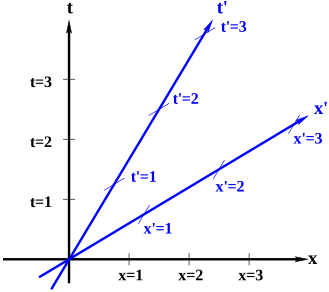
above) we can make a diagram which clearly shows this. To start, in
Diagram 3-4 I have shown the results of our discussion above in that I have
indicated where the tick marks would
appear on the x' and axes.
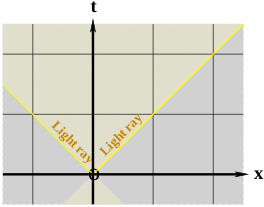
Next, in Diagram 3-5 I have drawn the and axes along with
lines of simultaneity and lines of constant position (for O) at each tick mark.
In addition, the upper half of a light cone centered at the origin is
shown. As you see (and as we would expect), it passes
through the points light-second, second;  light-seconds,
 seconds; etc.
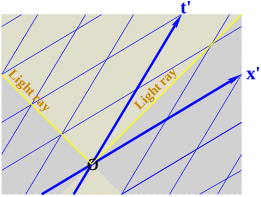
Continuing with the diagrams, Diagram 3-6 shows the and
axes along with lines of simultaneity and lines of constant position (for )
at each tick mark along those axes. Again, the upper half of a light cone
centered at the origin is also shown. As you see (and as we would again expect),
it passes through the points  light-second,
  second; etc.
Note that the light
cone itself is drawn exactly the same as it is in Diagram 3-5.
second; etc.
Note that the light
cone itself is drawn exactly the same as it is in Diagram 3-5.
Finally, I want to superimpose Diagram 3-5 and Diagram 3-6
to some extent onto Diagram 3-7. It would be quite cluttered to put all
the lines included in the two diagrams, but I want to include the lines which
make up , , , and . These lines are thus drawn on
Diagram 3-7, but they terminate where they meet the light cone which is
also shown. You should begin to see the relationship between the two different
frames of reference and the fact that the light cone itself is exactly the same
in both coordinate systems. This is a direct result from the fact that every
step we took in producing these diagrams used the assumption that the speed of
light is the same in all inertial frames of reference.

Though this concludes our discussion of space-time diagrams, we will continue to see them in the next section, because they can be vital tools for understanding paradoxes in special relativity.
Chapter 4: Paradoxes and Solutions
One misleading statement many people hear in connection with relativity is something like this: "Time moves slower for you as your speed increases." It is misleading because it implies some incorrect concepts. It implies that there is an absolute way to decide whether or not someone is truly at rest or moving (at a constant, non-zero velocity) when in reality this depends on your frame of reference. It implies that if you are moving at a constant velocity, then your clock is moving slower than some sort of "correct" clock which is truly not in motion. It also implies that you yourself might find your clock ticking slower than usual.
However, as I have mentioned earlier, motion is relative. There is no way to say that one object is truly at rest and another is truly moving at a constant velocity. You can only say that one object is moving at a constant velocity relative to another object. You can say that in the frame of reference of one observer (call him Joe) another observer (call her Jane) is moving at a constant velocity. Then, in Joe's frame of reference, Jane's clock is running slowly, and she is length contracted in the direction of her motion. However, in Jane's frame of reference, Joe is the one who is moving at a constant velocity relative to her. Because the laws of physics are the same for all inertial frames, we must be able to apply the same laws to Jane as we just applied to Joe. Thus, in Jane's frame, Joe's clock is the one which is running slowly, and Joe is length contracted in the direction of his motion.
This leads one to question whether or not relativity contradicts itself. If all motion is relative, we have concluded that each observer believes that the other observer's clock is running slowly, and each believes that the other observer is length contracted in the direction of motion. Isn't that a contradiction? For example, how can Jane's clock be running slower than Joe's and Joe's clock be running slower than Jane's? Well, these questions lead to various solvable paradoxes in special relativity.
As a note, the word "paradox" has a few different meanings, and when I use it here, I will have this meaning in mine: "a paradox is a statement that seems contradictory or absurd but that may in fact make sense." A "solvable paradox" is then a paradox that does in fact make sense when explained correctly, while an "unsolvable paradox" is a paradox for which the statement "may in fact make sense" doesn't hold (i.e. an unsolvable paradox is truly self-contradictory).
The paradoxes in special relativity are solvable, and below I will present two of these paradoxes along with their solutions.
The twin paradox deals with the question of "who's clock is running slower?" The story goes as followers: Two twins (say Sam and Ed) are both on Earth when one of them (say Sam) decides to leave the Earth by very quickly accelerating to a speed close to the speed of light. We then consider the two frames of reference after Sam has reached a constant velocity. According to special relativity, in Ed's frame of reference, Sam's clock is running slowly, while in Sam's frame of reference, it is Ed's clock which is running slowly.
Now, as long as the two are apart, it is not to hard to argue that the question is strictly dependent on your point of view. By this I mean that we can argue that there is no correct answer to the questions--that who's clock is running slower depends completely on what frame of reference you are in. However, how would we continue this argument if we added the following to the story:
At some point after Sam begins his trip away from the Earth, one of the twins decides to go meet with the other twin. Either Ed decides to accelerate away from the Earth and catch up to Sam, or Sam decides to accelerate back towards the Earth to go back and meet with Ed. We then ask this question: when the two twins are standing next to one another again, which one is older?
With the above addition to the story, there must be a definite answer to the final question. So, how can we continue to say that the answer depends on your frame of reference? Well, as we will see, the final question does have a definite answer, but the question of how this came about is dependent on who you ask.
4.1.1 Viewing it with a Space-Time Diagram
So, now we will try to understand the twin paradox by using our old friend,
the space-time diagram. To do this, we have to decide on some specifics. First,
we will say that the relative motion of Sam and Ed is . So, after Sam has
accelerated to a constant speed, he will be traveling at with respect to
the Ed. (Of course, in Sam's frame, it is Ed who is moving at a speed of
away from Sam.) Next, we need to decide who will be the one who eventually
accelerates to go and meet with the other twin. In our case, we will look at the
situation where Sam turns around to go back and meet with Ed. Finally, I should
mention that the accelerations we will be using will be "instantaneous"
accelerations. This means that they take no time to accomplish. In the real
world, it would (of course) take time to accelerate, and while this would make
the space-time diagrams look differently, the basic ideas we will discuss still
hold.
Now we look at the space-time diagrams. In Diagrams 4-1 and 4-2 below, I have drawn the whole trip in two parts. In Diagram 4-1, you see Sam headed away from Ed, and in Diagram 4-2, you see Sam after he has turned around and is headed back to Ed.
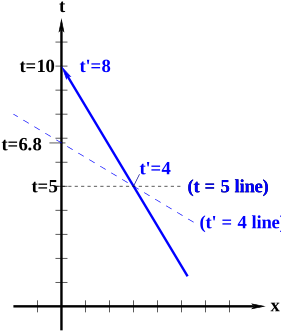
Now, to explain the diagrams: Ed (the twin on Earth) is represented by the
and axes while and denote the coordinate system for Sam.
Now, at the origin, Sam instantaneously accelerates to the speed of . He then proceeds away from Ed until Sam sees that his own clock read 4 years
(just to pick some unit of time--which means that the distances would be in
light-years). When Sam sees his own clock read 4, he turns around with an
instantaneous acceleration. At that point, we switch to Diagram 4-2. In
that diagram, Sam heads back to Ed.
4.1.2 Explaining the "First Part"
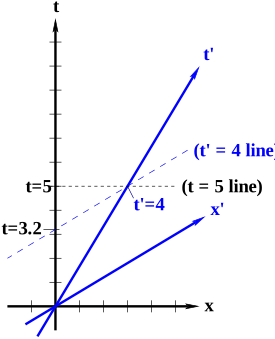
Now let's concentrate on the first of the two diagrams. Just before Sam
turns around, his clock reads 4 years. At that point I have drawn two lines of
constant time (or lines of simultaneity)--one for each observer. The line
parallel to the axes is (of course) the line of simultaneity for Ed which
passes through the event "Sam's clock reads 4 years". Note that this line of
simultaneity for Ed also passes through the event "Ed's clock reads 5 years".
Therefore, in Ed's frame of reference, the events "Sam's clock reads 4 years"
and "Ed's clock reads 5 years" are simultaneous events. This diagram thus
explains how in Ed's frame of reference, Sam's clock is running slower than Ed's
by a factor of 0.8 (that's one over when  ).
).
However, the line of simultaneity we were looking at is not a line of
simultaneity for Sam. Sam's line of simultaneity which passes through the event
"Sam's clock reads 4 years" is the one marked " line". This line also
passes through the event "Ed's clock reads 3.2 years". Therefore, in Sam's frame
of reference the events "Sam's clock reads 4 years" and "Ed's clock reads 3.2
years" are the simultaneous events. This diagram thus explains how in Sam's
frame of reference, Ed's clock is running slower than Sam's by a factor of 0.8.
line". This line also
passes through the event "Ed's clock reads 3.2 years". Therefore, in Sam's frame
of reference the events "Sam's clock reads 4 years" and "Ed's clock reads 3.2
years" are the simultaneous events. This diagram thus explains how in Sam's
frame of reference, Ed's clock is running slower than Sam's by a factor of 0.8.
So, the idea that they each believe the other person's clock is running
slowly can be explained. We see that it is, indeed, a question of which frame of
reference you are in, because different events are simultaneous in different
frames. It is interesting to note that this situation only seems paradoxical in
the first place because we are not use to the fact that simultaneity isn't
absolute. In everyday life, we get the idea that when two events happen at the
same time, then that is an absolute fact. However, relativity shows us that this
is not the case, and once we realize that, we can understand how each observer
can believe the other observer's clock is running slowly.
With this "first part" of the paradox solved, we must now move to the second part and ask this question: "how do we explain what happens when the twins come back together?"
4.1.3 Explaining the "Second Part"
In Diagram 4-2 Sam has seen his own clock read 4 years, and he then instantaneously accelerated to head back towards Ed. Right after the acceleration, Sam's clock still basically reads 4 years. Note, however, that Sam's frame of reference has changed. The inertial frame he was in before he turned around is different from his inertial frame after he turned around. I have thus drawn his new time line and a line of simultaneity (one which passes through the event "Sam's clock reads 4 years") for his new frame of reference.
Once again we will look at the simultaneous events in Ed's frame and in Sam's (new) frame. Since Ed hasn't accelerated, he has remained an inertial observer, and his frame of reference hasn't changed. Thus, in his frame the events "Ed's clock reads 5 years" and "Sam's clock reads 4 years" are still simultaneous. However, Sam is in a new frame of reference, and in this frame the events "Ed's clock reads 6.8 years" and "Sam's clock reads 4 years" are the simultaneous events.
So, each observer has his own explanation for the final outcome of the
situation. For Ed, Sam's clock is ticking slowly before the turn-around, nothing
significant happens when Sam turns around, and Sam's clock continues to tick
slowly after the turn-around (because he is still moving at with respect
to Ed). That is how Ed explains why he has aged 10 years and Sam has only aged 8
years when they get back together at the end of Sam's trip.
However, for Sam, the explanation is different. Before the turn-around, Sam is in a frame of reference in which Ed's clock has been ticking slow, and it has ticked 3.2 years while Sam's clock has ticked 4 years. After the turn-around, Sam is in a frame in which Ed's clock (though it is still ticking slowly) has already ticked 6.8 years while Sam's clock still reads only 4 years have passed. Note that since Ed's clock is still running slowly in Sam's new frame of reference, it will still only tick another 3.2 years (in Sam's frame) during the last half of the trip, while Sam's clock ticks another 4 years. However, since in Sam's new frame, Ed's clock has already ticked 6.8 years, the additional 3.2 years will make a total of 10 years of ticks for Ed's clock. Meanwhile, Sam has seen his own clock tick a total of only 8 years.
And there you have it. Each observer agrees (as it must be) that when the two are back together again, Ed will have aged a total of 10 years while Sam has only aged a total of 8 years. They each have completely different ways of explaining how this happened, but in the end, they each agree on the final outcome.
There are four specific things I want to make note of concerning the twin paradox as I have explained it.
First, we should note that the outcome of the above thought experiment (i.e. the fact that Sam ended up younger than Ed) is completely dependent on the fact that Sam turned around and headed back to Ed. If instead Ed had done the acceleration when he saw his own clock tick 4 years and had headed over to meet Sam, then Ed would be the one who had aged a total of 8 years while Sam had aged 10 years. Notice that the twin who undergoes the acceleration must actually have a physical force applied to him to cause that acceleration. During the acceleration he is no longer an inertial observer (this is why his frame of reference shifts while the other twin's frame does not shift). That differentiates his situation from the twin who does not accelerate, and that breaks the symmetry between the two observers. Unless one of them goes through an acceleration, their situations are completely symmetric, and there is no absolute answer to the question "which twin is younger?"
Second, I want to note something particular about the acceleration Sam went
through. Look back at the lines of simultaneity drawn for Sam's frame before and
after he accelerated. As we noted, the point where his "" line of
simultaneity cross the axis (Ed's position) shifts upward when Sam turns
around. Notice, however, that if Sam had taken a longer trip, then he would have
done the acceleration when he was further from Ed. Then that "shift" would have
been even larger, and after the acceleration, Sam's new frame of reference would
be one in which Ed's clock had "jumped" ahead an even greater number of years.
So, for Sam, the longer the trip he takes, the bigger the change will be when he
switches his frame of reference, and that will make him an even greater number
of years younger than Ed when they get back together. Of course, for Ed, the
longer the trip is for Sam, the longer Sam's clock will be running slowly. So,
Ed too agrees (with a different explanation) that Sam will be more years younger
than Ed in the end if the trip is longer. As a final point on this, note that
when Sam first accelerates to start his trip, he is right next to Ed, so the
acceleration doesn't have much effect at all (as is true for his final
acceleration at the end of the trip). That is why we basically ignored those
accelerations.
Third, I want to note something about Sam's explanation of the events. Recall that when he changed frames of reference, his clock read 4 years while (in his new frame) Ed's clock read 6.8 years. One may think that Sam has thus changed to a frame where Ed's clock has been running faster; however, we know that in Sam's new frame, Ed is still moving with respect to Sam. Thus, in Sam's new frame Ed's clock has still been running slowly the whole time. To understand how this can be, consider a third observer (Tim) who has always been in the frame of reference which Sam has during the last part of the trip. Let's say that Tim was traveling along (going to Earth) when he saw Sam headed towards him, and to Tim's surprise, Sam turns around and joins Tim in Tim's frame of reference as the two come together. Thus, after Sam turns around, he and Tim are moving together, side by side. Now, Tim notices that right after Sam turns around, Sam's clock reads 4 years. Regardless of what Tim's clock reads, he can reset his clock to 4 years, and we can backtrack 4 years along Tim's path to identify the origin of Tim's frame (Sam's new frame). In Diagram 4-3 I have drawn (along with everything in Diagram 4-2) Tim's path, the origin (o') of Sam's new frame of reference, and a line of simultaneity for Tim's and Sam's frame at that origin.
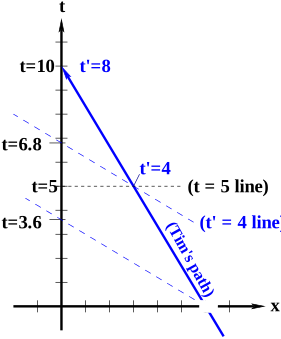
Notice that for Sam's new frame (the frame Tim has always been in) if when Sam turns around, then the event at Ed's position which is simultaneous
with the origin in this frame (o') is the event "Ed's clock reads 3.6 years".
And there you have it. In Sam's new frame, while it is true that Ed's clock is
always been running slow, at the "beginning" for this frame (i.e. at its origin)
Ed's clock started at 3.6 years. In this new frame of Sam's, Ed's clock had a
"head start" (so to speak) when compared to Tim's clock. That is why Ed's clock
already reads 6.8 years while Sam's clock reads only 4 years in Sam's new frame.
In the end, we can describe the events in whatever frame of reference we wish,
and though they may each have different explanation for what actually happens,
they must all agree with the final outcome when the two twins come back
together.
The final note I want to make is, again, about Sam's "view" of the events. When we say that before Sam's turn-around he is in a frame of reference in which Ed's clock reads 3.2 years, and after the turn-around Sam is in a frame of reference in which Ed's clock reads 6.8 years, one might be tempted to say that as Sam accelerates, Ed's clock speeds up in Sam's frame of reference. Of course, this doesn't change the way Ed sees his clock running, but it is only the way things occur in Sam's changing frame of reference. However, think about what would happen if Sam quickly changed his mind after the turn-around and immediately turned back around to his original heading. Then, in this new acceleration, Sam went from a frame where Ed's clock read 6.8 years to a frame where Ed's clock reads 3.2 years again. One would thus argue that Ed's clock went backwards in Sam's changing frame of reference. Again, this doesn't have any real significance to the way Ed is reading his own clock, but we have to come to terms with the fact that Sam's new acceleration caused Ed's clock to go backwards in Sam's changing frame. Perhaps the best way to think about this is simply to realize that Sam is not in an inertial frame since he is accelerating. Rather, Sam is simply changing into various inertial frames, and in each of these inertial frames, moving clocks do tick slowly, time does goes forward in all frames, etc. Either way you like to think about it, in the end, we can explain the outcomes as needed.
4.2 The "Car and Barn Paradox"
The "Car and Barn" paradox deals with the question of "whose lengths are shorter?" We have a barn whose front and back doors can be quickly open and closed. There is also a car which is just long enough so that if you try to fit it in the barn, and the barn doors close, they would close down on the front and back bumpers of the car. Now, an observer in the car (say, Carol) speeds the car towards the barn at a significant fraction of the speed of light. One might then argue the following: from the point of view of an observer sitting in the barn (say, Bob) the car will be length contracted, and at some point it will be completely inside the barn. Bob then reasons that he can close and open both barn doors while the car is completely inside the barn. However, Carol will argue that it is the Barn which moving with respect to here, and thus it the barn which is length contracted. So, she argues, if Bob tries to close both doors at the same time as the car goes through the barn, then the doors will smash into the car.
We thus want to ask whether or not the barn doors do smash into the car if Bob tries his idea, and how does each observer explain the outcome.
4.2.1 Viewing it with a Space-Time Diagram
As we did with the twin paradox, here we will look at a space-time diagram of the car and barn experiment in order to explain the paradox. We will draw our diagrams such the relative velocity of Carol and Bob is 0.6 c. In Diagram 4-4 I have drawn the situation keeping Bob's frame of reference in mind. To keep the diagram from getting too cluttered, a second diagram (Diagram 4-5) of the same situation will be used to mark points according to Carol's frame of reference.
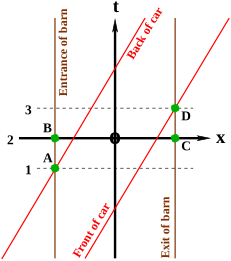
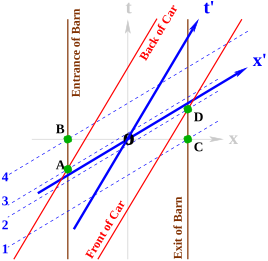
In the diagrams we have the following: The red lines indicate the paths of the front
and back of the car (as marked) through space-time. The brown lines indicate
the paths of the entrance and exit of the barn (as marked) through space-time.
Hopefully it is apparent to the reader that the car travels from left to right
(with respect to the barn) and passes through the barn. Also note that at the
point where the entrance and exit of the barn cross the axis (i.e. when the
front and back of the barn are both at in Bob's frame), both the front
and back doors quickly close and open again. Those points are labeled B and C.
We are interested in six different occurrences (though only 4 are shown in the diagrams). The ones not shown in the diagrams are, first, the front of the car enters the barn, and second, the back of the car exits the barn. These would appear much lower and much higher (respectively) in the diagram than is being shown here. The four events that we do note in the diagrams are (A) the back of the car enters the barn, (B) the entrance door of the barn closes and opens again, (C) the exit door of the barn closes and opens again, and (D) the front of the car exits the barn. In the diagrams, I have marked each of these events with the letters given and drawn lines of simultaneity (marked with dashes) for the observers.
In Diagram 4-4, we see that for Bob (whose lines of simultaneity are drawn in that diagram), (A) is the first event which happens, and everything that occurs simultaneous to (A) in Bob's frame of reference lies on the line marked with a 1. The next two events in Bob's frame are (B) and (C), which occur simultaneously. Everything which occurs simultaneous to these events lies on the line marked with a 2. Finally for Bob, (D) occurs, and everything which occurs simultaneous to it lies on the line marked with a 3. Note that for Bob, as the back of the car enters the barn--event (A)--the front of the car has yet to exit the barn. Also, when the doors close and open--events (B) and (C)--simultaneous in Bob's frame, the front and back of the car are inside the barn (the two red lines are inside the two brown lines along the line marked 2). Thus, in Bob's frame, the car is smaller than the barn, and it is inside the barn when the doors close and open. Finally, after both doors close and open, the front of the car exits the barn--event (D)--in Bob's frame.
However, in Diagram 4-5 we see simultaneous events marked from
Carol's frame of reference. Again, the lines of simultaneity at each event are
marked with dashes (but here they are drawn from Carol's
frame and are blue). Now, we see that the "lowest" line of
simultaneity on the diagram from Carol's frame of reference passes through the
event (C), the exit door of the barn closes and opens. Thus, this event occurs
first in Carol's frame. Everything occurring simultaneous with it in Carol's
frame is on the line marked with a 1. Next in Carol's frame, event (D)
occurs, followed by event (A), while event (B) occurs last. The events occurring
simultaneous with these events are on the lines marked 2, 3, and 4,
respectively. Thus, according to Carol's frame, things happen as follows: First,
while the front of the car is in the barn, but before the back of the car enters
the barn, the exit door of the barn closes and opens. Next, the front of the car
exits the barn. (Note that while the front of the car is then outside the exit
of the barn at this point, the back of the car has yet to enter the barn in
Carol's frame--look along the axis, for example. So for Carol, the barn is
smaller than the car.) Next, the back of the car enters the barn in Carol's
frame. Finally, after the front of the car has exited the barn and the back of
the car has entered the barn, the entrance door of the barn closes and opens.
And there you have it. In the end, each observer must agree that the car
gets through the barn without smashing into the doors. However, each frame of
reference offers a different explanation for how this comes to be, because in
each frame, different events are simultaneous with one another. In Bob's frame,
the car is in the barn all at once while the doors close and open
simultaneously. However, in Carol's frame, the doors do not close
simultaneously, and the car is never completely in the barn.
So, I hope you have seen the power of space-time diagrams when it comes to explaining things in special relativity. When we simply say that moving clocks run slower and moving rulers length contract, we miss a real understanding of special relativity. That understanding comes from realizing that the actual coordinates in space and time for events are different for different observers who are moving with respect to one another. This relationship can be viewed with space-time diagrams, and the answers to many nagging questions in special relativity can be explained if one understands these diagrams.